Ethiopian Kafa ForestCoffee Bean Intro:

Front Street Coffee: Ethiopia · Kafa Forest Coffee Beans Region: Kafa Primeval Forest Flavor: Bergamot, white floral, orange, apricot
We often hear the saying that Ethiopia is the birthplace of Arabica coffee. To be precise, it should be the Kaffa region of Ethiopia (Kaffa Zone) where coffee was first discovered. To this day, countless wild Arabica coffee parent trees still grow in the misty forests here, under protection.
Front Street researched and found that the term "Kaffa" is translated from the English "Kaffa," and some places also write it as "Kafa." It originates from the name of an ancient kingdom, historically known as the Kingdom of Kaffa.
Located in the southwest of Ethiopia Kaffa Zone Later, this kingdom was annexed by the Ethiopian Empire in 1897, and the Kaffa region got its name from there. Administratively, the Kaffa region currently belongs to the Southwest Ethiopia Peoples' Region of Ethiopia, situated in the northern part of the autonomous region.
Ethiopia's climate is extremely polarized—one half is a humid and lush rainforest zone, the other half is arid desert and Gobi. When viewed from above, the western part of the country is the greenest area, and a significant portion of these lush green zones belongs to the Kafa Biosphere Reserve, located at the junction of the Gambela, Oromia, and SNNPR regions.
Signpost leading to the coffee parent tree forest in the Kaffa region As the most forested area in Ethiopia, the primeval forests of the Kafa Biosphere are globally recognized as the birthplace of coffee and are also the genetic treasure trove of the Arabica coffee we are familiar with today. The "Gesha" in the Gesha origin story is actually one of the areas of Kaffa, located in the western region.
This place is also designated by UNESCO as a biodiversity reserve . The Kafa Biosphere Reserve covers approximately 760,144 hectares, with forested areas reaching 422,260 hectares, accounting for a coverage rate of 55.6%. Over centuries of natural evolution, the Kafa Forest has nurtured about 5,000 coffee tree species, considered the richest genetic treasure trove of Arabica coffee today, hence also earning the title of "natural coffee variety museum."

This place is not much different from the misty rainforests we imagine—uneven mountains, lush and dense vegetation, humid air, muddy ground, and a rich diversity of species living here. The difference lies in the large number of ancient coffee trees forming an important part of the ecosystem here. Coffee grows under dense, towering shade trees. There are no artificially cultivated crops, only wild plants that naturally sprout and propagate through seed drops.
However, with people’s unregulated land reclamation and continuous deforestation, transforming vast areas of wild forest into arable land, this forest is also facing unprecedented threats. According to statistics from the Food and Agriculture Organization of the United Nations (FAO), between 1988 and 2008, the vegetation exploitation rate of the Kafa Forest reached 11,000 hectares per year. This means that if no measures are taken to stop it, this primeval forest could completely disappear within the next 10 to 20 years.
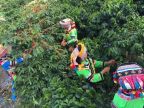
Freshly picked coffee cherries in the Kafa primeval forest Starting in 2010, the Kafa primeval forest area was listed as an international ecological conservation zone by the NABU organization of the United Nations, and a project to protect the origin of wild Arabica coffee was initiated, dedicated to preventing the last remaining natural coffee forest from being destroyed. Currently, around 30 coffee production cooperatives have been established around the Kafa reserve, harvesting ripe red cherries from the primeval forest.
Unlike the pastoral coffee-growing model where farmers plant coffee trees in their backyards, the Kafa misty forest is most representative of wild coffee production. Coffee trees all grow in shaded environments at altitudes of 1400–2100 meters. Pristine ecology, microclimates, red soil, and abundant rainfall provide optimal growing conditions for the coffee trees.

To taste the flavor of such "wild coffee," Front Street also obtained a washed batch of Kafa Forest coffee beans and used a medium-light roast level to highlight its bright floral and fruity notes.
Within 24 hours after roasting, Front Street immediately cupped the coffee. The dry fragrance of this washed Kafa Forest coffee exhibited elegant white floral notes, lemon, and citrus-like aromas reminiscent of oranges. Peel After pouring hot water, the aroma of ripe apricots and sweet oranges emerged.

Upon tasting, Front Street first perceived a bright and clean fruit acidity, with rich aromas of lemon, sweet orange, nectarine, green tea, and caramel. As the temperature slightly dropped, the coffee developed a juicy sensation of apricots and green grapes. The overall texture was light, and after swallowing, a lingering sweetness of melons and nuts remained in the mouth, creating a very pleasant experience.