Rwanda Nyanzamu Washed BourbonCoffee Bean Intro:
Premium African Rwanda Coffee Beans – Rwanda Nyanzamu Washed Bourbon Coffee Beans
Rwanda, Nyanzamu
Region: Western Rusizi District
Washing Station: Nyanzamu Washing Station Nyakarenzo
Altitude: 1695m
Variety: Bourbon
Processing Method: Washed Processing Method

Rwanda Coffee Development
Coffee cultivation in Rwanda began during the colonial era. Although coffee was the main crop, the quality of Rwandan coffee was not outstanding, and its status in the global coffee scene was low, attracting little attention. Pioneering Coffee discovered that Brazil, which also experienced colonial rule, once produced coffee beans prioritizing quantity over quality, leading to a period when it was notorious for poor coffee quality.
Most of the coffee varieties grown in Rwanda are Bourbon. The country is predominantly mountainous and plateaued, with most coffee trees planted on mountains between 1700 and 2000 meters above sea level, earning it the nickname "Land of a Thousand Hills."

The Rwanda National Agricultural Export Development Board (NAEB) stated that Rwanda’s coffee strategy is "to position Rwanda as a producer of specialty coffee." To better promote national development and prosperity through the coffee industry, increasing coffee exports to drive economic growth, rising coffee prices are a sign of success. The government will focus on improving production and processing measures.
Rwanda’s current prosperity is largely due to strong government investment and support from international NGOs and private organizations. In 1994, Rwanda experienced a genocide that drastically reduced its population and halted the coffee industry.
By 1995, Rwanda gradually regained stability. In 2000, with funding from USAID, the PEARL and SPREAD programs were established to support agricultural reconstruction in Rwanda and enhance coffee quality, helping farmers achieve better incomes.
Pioneering Coffee has also observed the rapid development and stabilization of Rwandan coffee quality, recently sourcing several batches of coffee beans from different regions in Rwanda, discovering flavors distinct from other African coffees.

Rwanda Coffee Regions
Rwanda’s land area is only four times that of Guangzhou. Its small size and similar coffee-growing altitudes result in minimal flavor variation among coffee beans from different regions.
Rwandan Arabica coffee bean regions are mainly distributed in the south and west. The southern Huye Mountains and Nyamagabe areas, with higher altitudes, produce coffee beans with floral and citrus notes. Meanwhile, the Nyamasheke region by Lake Kivu in the west is known for rich, aromatic, and juicy high-quality coffee.
Although flavor differences between regions are not significant, subtle distinctions exist. Many often ask Pioneering Coffee how to tell them apart, feeling that flavor is somewhat abstract. In reality, Pioneering Coffee has undergone extensive flavor recognition training to distinguish regional coffee profiles, which requires time, effort, and persistence.

Nyanzamu Washing Station
The Nyanzamu Washing Station Nyakarenzo is located in Rusizi, western Rwanda, bordering the Democratic Republic of the Congo and Burundi. The washing station is composed of over a thousand smallholder farmers, three-quarters of whom are women.

Rwanda Coffee Processing Methods
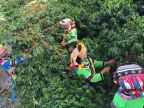
Under the PEARL and SPREAD coffee development initiatives, Rwanda has built 46 coffee washing stations. Currently, washed processing is the primary method for Rwandan coffee beans. Ripe coffee cherries are handpicked—shown below are Rwandan farmers selecting ripe cherries. The cherries are then depulped, undergo 12–18 hours of washed fermentation to remove mucilage, and are finally sun-dried to a moisture content below 14%.

When recommending coffee beans from a specific region, Pioneering Coffee typically starts with washed beans, as this method best highlights the intrinsic flavors of the coffee, allowing insight into the region’s flavor characteristics. Thus, Pioneering Coffee believes Rwanda’s early adoption of washed processing as its primary method was a clear and strategic choice.
Rwanda Bourbon Coffee Beans
Over 90% of Rwanda’s coffee varieties are early-imported Bourbon and Bourbon-family hybrids, which are resilient to natural disasters. Bourbon coffee was once wildly popular across Latin America but saw reduced cultivation due to poor disease resistance. Some of Pioneering Coffee’s current Latin American Bourbon beans include Brazilian Red Bourbon, Brazilian Yellow Bourbon, and Colombian Pink Bourbon. In comparison, Rwandan Bourbon still holds advantages, which is one reason Pioneering Coffee sources Rwandan beans.
Rwanda Coffee Wins COE Championship
2008In [year], during the SPREAD program, Rwanda hosted its first Cup of Excellence (COE) competition—the first COE ever held in an African nation. Rwanda’s Anomera Premium Washed Bourbon defeated Jamaica Blue Mountain #1 and Sumatra Mandheling G1 Special Selection to claim the championship.
Although Rwanda performed well in COE, it was twice disqualified for potato defect—a flaw in green bean quality that can sometimes be detected in raw beans but is more often identified during roasting or grinding. The causes of potato defect are debated, possibly linked to bacteria left by insects in coffee cherries, which can destroy up to 35% of yields. However, the recent Rwandan beans sourced by Pioneering Coffee showed no signs of potato defect.
Roasting Recommendations
Given Rwanda’s bright acidity, to highlight this characteristic, Pioneering Coffee recommends medium-light roasting . Deeper roasts result in greater loss of fruity acidity.

Machine: Yangjia 800N, 550g of green beans