Gesha Village ChakaCoffee Bean Intro:

Fore Street Coffee: Ethiopian Gesha Village Chaka Coffee Beans
Country: Ethiopia
Region: Gesha Village Estate
Elevation: 1900–2050 meters
Varieties: Gori Gesha, Gesha 1931, Illubabor
Processing method: Natural process
Flavors: Berries, oolong tea, lemon, citrus
Let’s first clarify the definition of Gesha coffee. In the narrow sense, Gesha coffee refers to the variety discovered at Panama’s Hacienda La Esmeralda. Its spread roughly followed this path: from Ethiopia’s Gesha to Kenya, then via Tanzania to Costa Rica, and eventually to Panama. After varietal purification, it further disseminated to neighboring countries.

Because its original source is the Kaffa Gesha region in southwestern Ethiopia, it was named Gesha.
In the broad sense, Gesha coffee refers to coffee beans currently grown in the Kaffa Gesha region. This is somewhat like how Luogang oranges or Qimen black tea are named—regardless of the specific variety, anything grown in that area is naturally referred to as such.
Now, let’s talk about the Kaffa Forest. The Kaffa region was once the site of the Kingdom of Kaffa, which existed for over 600 years before being annexed by Ethiopia about 100 years ago. A few years ago, it became part of the newly established Southwest Ethiopia State. The Kaffa Forest refers to the contiguous forested areas in this region, which account for over 55% of Ethiopia’s total forest coverage and are designated as a United Nations natural ecological reserve.

Familiar names like Gesha, Banko Mashiko, or Wush Wush (southwest of Kaffa’s capital, Bonga) are all located within this “Kaffa Forest.” Even if we conservatively define only coffee grown in the Kaffa Gesha region as Gesha coffee, there’s still quite a lot. After all, satellite imagery shows the Kaffa Forest’s green expanse is remarkably prominent—who knows how many coffee varieties it actually harbors?
Ethiopia is a sacred place in the hearts of many. This country is the birthplace of coffee and is now Africa’s largest Arabica coffee producer. It also boasts the world’s largest coffee gene bank, with an abundance of coffee varieties, including the renowned Gesha variety.
Ethiopia
Ethiopia is located in the northeastern part of Africa, bordering Djibouti, Somalia, Sudan, South Sudan, Kenya, and Eritrea. The country is predominantly mountainous and plateau, with most of it belonging to the Ethiopian Highlands. The central and western parts form the main body of the highlands, covering two-thirds of the nation. The East African Rift Valley runs through the entire territory, and the average elevation of the mountains is nearly 3000 meters.

Due to the high elevation, the climate here is pleasant, with an average annual temperature of 16°C. The plateau region has a tropical savanna climate, while the mountains have a highland mountain climate. The low-elevation eastern and northern areas have a tropical desert climate. The year is roughly divided into dry and rainy seasons, with an annual rainfall of 1237 mm. The country is water-rich, home to numerous lakes and rivers, earning it the title “Water Tower of East Africa.” With nearly 50 volcanoes, abundant water resources, diverse climates, and high-altitude mountainous regions, it is an ideal coffee-growing area.
Bench Maji
The Bench Maji region, also called the Bebeka region (Bebeka), is located in southwestern Ethiopia, within the Southern Nations, Nationalities, and Peoples' Region. It is a district where Bebeka serves as the capital and is just a few kilometers from South Sudan. In the north of this region lies the renowned Gesha Village Coffee Estate.

Documentary director Adam Overton and his photographer wife Rahel Samuel filmed a coffee documentary for the Ethiopian government in 2007. Subsequently, they began searching for suitable land in the Gori Coffee Forest of the Bench Maji (Benchi Maji) area to introduce mature South American market operational methods to Ethiopia.
Gesha Village Coffee Estate is located in Gori, where one of its varieties, Gori Gesha, was collected by the estate owner from the nearby wild forest. Gesha Village Coffee Estate is entirely different from most Ethiopian farms—it is not a small farm but a large 500-hectare operation with its own wet mill and laboratory. Most notably, the entire farm is dedicated to cultivating the locally discovered Gesha variety. Compared to the scattered planting in the region, this approach yields higher-quality coffee beans.

Gesha Village began constructing the farm in October 2011, with its first harvest in 2015. Due to overwhelmingly positive feedback, they held their first international auction on May 31, 2017, with the assistance of Panamanian coffee grower Willem Boot. They offered 21 micro-lots, 19 of which were 120 kg each, with the rest smaller. Bidders from Europe, North America, Asia, and Australia responded exceptionally enthusiastically. The top lot sold for $85 per pound, breaking all previous auction records for African beans.
Varieties and Plots
Currently, Gesha Village cultivates three coffee varieties: Gesha 1931, Gori Gesha, and Illubabor Forest 1974. The estate is divided into eight plots, each dedicated to a single variety. The Oma, Surma, and Narsha plots grow Gesha 1931; the Bangi, Shewa-Jibabu, and Shaya plots grow Gori Gesha; and the Gaylee and Dimma plots grow Illubabor. Coffee cherries harvested from each block are labeled to indicate their origin and tracked throughout the process—from the mill to export—via an internal tracking system.

Gesha 1931: The Gesha variety was originally discovered in Ethiopia’s coffee forests in 1931. Due to its rust resistance, it traveled through multiple countries before gaining fame in Panama. This particular Gesha variety is the native strain found by the estate owner in the Gesha Forest. Because its genetic profile closely resembles that of the Panamanian Gesha, it was named Gesha 1931.
Gori Gesha: In 2011, after the establishment of Gesha Village, the estate owner discovered a native Gesha variety in the Gori Forest, 12 miles from the estate, leading to its naming.
Illubabor Forest 1974: Discovered during an expedition in the Illubabor Forest in 1974, this variety was later developed by the Ethiopian Research Center into a resistant strain. Currently, only Gesha Village cultivates it.
Gesha Village Grading
Gesha Village’s coffee classification draws inspiration from the business models of some Panamanian estates. Unlike Ethiopia’s traditional grading system, Gesha Village currently divides its coffee into five tiers: Auction Lots, Gold Label, Red Label, Green Label, and Chaka.

Auction Lots (Champion’s Reserve/Farm Reserve): These lots account for only 3.7% of Gesha Village’s annual production and represent the estate’s highest-tier selections, rigorously screened. The auction lots are further divided into Champion’s Reserve and Farm Reserve, currently available only through Gesha Village’s global auctions.
Gold Label (Rarities): This tier represents the highest quality among non-auction lots, making up just 10% of the estate’s production.
Red Label (Growers Reserve): Red Label lots account for 15% of the estate’s production and must score 88 or above in SCA cupping evaluations.
Green Label (Single-Terroir): Green Label lots have no cupping score requirement but can be traced back to specific plot, variety, processing method, and harvest date information.
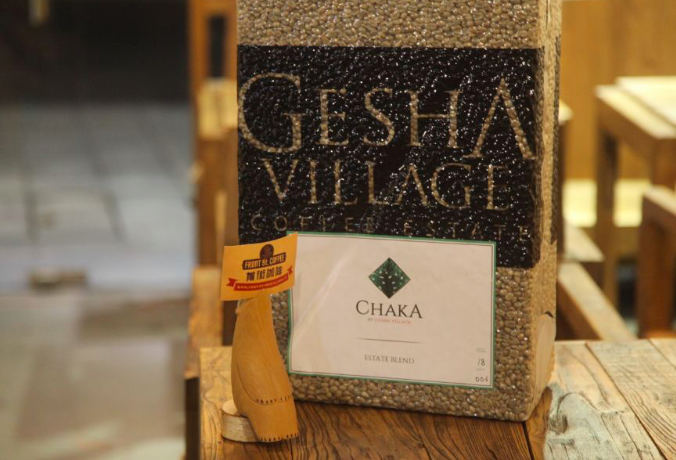
Chaka (Chaka): Chaka lots blend coffee from all plots and varieties across the estate, without emphasizing subdivision.
Gesha Village Chaka.jpg