Source:Best Coffee > News Author:qjroot Published:2025-03-29 09:45:00
Guatemala
Guatemala is located in the southern part of the North American continent and is a country with both land and sea. It borders Mexico to the west and north, Belize to the northeast, Honduras and El Salvador to the southeast, faces the Gulf of Honduras of the Caribbean Sea to the east, and the Pacific Ocean to the south. It has a coastline of about 500 kilometers, and forests cover 38% of the country's total area.
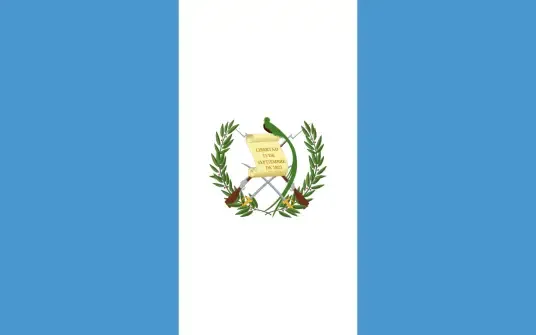
The flag of Guatemala consists of three vertical rectangles of equal width. The middle rectangle is white, symbolizing the pursuit of peace, while the two side rectangles are blue, representing the Pacific Ocean and the Caribbean Sea. At the center of the white rectangle is the national emblem of the country. The emblem is circular, featuring an open scroll with the words “15 de Septiembre de 1821, Libertad” written in Spanish, commemorating Guatemala’s independence from Spanish colonial rule. On the scroll stands the resplendent quetzal, Guatemala’s national bird, also known as the “bird of freedom,” which symbolizes liberty, patriotism, and friendship. Behind the scroll are crossed rifles and swords, symbolizing the people’s readiness to defend the nation’s freedom at all times.
Two-thirds of Guatemala’s territory consists of mountains and highlands. The western region is home to the Cuchumatanes mountain range, and the southern region features the Sierra Madre mountains, both part of the volcanic belt. The country has 37 volcanoes, among which Tajumulco Volcano, standing at 4,211 meters above sea level, is the highest peak in Central America. The northern part is mainly the Petén lowlands, a tropical rainforest area, while the main cities are located in the mountain basins of the southern region.
Coffee Regions
Huehuetenango: Huehuetenango is a non-volcanic coffee-growing region in Guatemala and one of the highest-altitude regions, with plantations situated at elevations between 1,800 and 2,100 meters. The name originates from Nahuatl, meaning “land of the ancients” or “land of the ancestors.” Huehuetenango is located in the western part of the country, at the foot of the Cuchumatanes mountain range, which is the highest non-volcanic mountain range in Central America. Due to the large amount of hot air blowing from the tropical plains of Tehuantepec in Mexico toward these mountains, the region is protected from frost, allowing coffee to be grown at higher altitudes. The area also has abundant rivers and water sources, making it an ideal location for cultivating high-quality coffee.
Nuevo Oriente: The Nuevo Oriente region is located in eastern Guatemala, adjacent to Honduras. It is the youngest coffee-growing area in the country, with coffee cultivation only beginning here in the 1950s. The region experiences abundant rainfall year-round and has relatively high altitudes, ranging from approximately 1500 to 2050 meters. As a result, it is often shrouded in light mist, receives less sunlight, and is more humid compared to other regions. Nuevo Oriente was once one of the poorest and most isolated areas in Guatemala. In ancient times, this region was a volcanic zone, which has endowed its soil with rich minerals. Coupled with ample rainfall and high elevation, the coffee beans produced here exhibit quite complex and varied flavor profiles. Among our offerings, there is a honey-processed Gesha coffee bean from the Nuevo Oriente region. It offers aromas of white flowers, with flavors of sweet orange and bergamot upon tasting, a toffee-like sweetness, and a honey-like smooth mouthfeel.
Antigua: The Antigua region is surrounded by three volcanoes—Agua, Fuego, and Acatenango. Most of the coffee is grown on the valley floor, at elevations between 1,500 and 1,700 meters. Thanks to the active Fuego volcano, humidity remains consistently around 65% year-round. Shade-grown cultivation is predominantly used, which protects the coffee plants from frost damage during cold weather. The dense shade and very shallow groundwater create a unique microclimate, combined with fertile volcanic soil and suitable humidity, contributing to the bright acidity and fruity notes characteristic of Antigua coffees.

Related Reading


Comments (0)
Loading comments...
With you, wherever you are! We provide useful features to help you find new things you'll love