Source:Best Coffee > News Author:qjroot Published:2025-12-14 16:43:43

Recently many friends have bought drip bag coffee and asked for brewing recommendations. Although drip bag coffee is convenient, it feels unfamiliar to those who have never tried it. So Front Street is here to sharehow to brew drip bag coffee!
The History of Drip Bag Coffee
In 2001, UCC Ueshima Coffee of Japan invented drip bag coffee and registered a patent, then brought it to market. In Japanese, it is called "one-cup brewed coffee." This is because the principle is to put ground coffee into a non-woven fabric or cotton paper filter bag, with two paper holders on the outside. Once opened, it can be hung on the rim of a narrow-mouthed cup, and after brewing you simply lift it out to enjoy rich black coffee. The good part is that it is very convenient; the bad part is that once coffee is ground, it quickly loses its aroma, which is why FrontStreet Coffee only ships drip bags made within 5 days.

And those two pieces of paper resting on the cup rim like "ears" are the origin of the name "drip bag." Because it is simple to use and portable, and the brewed coffee tastes much purer and richer than instant coffee, drip bag coffee now accounts for 15% of Japan's regular coffee market share. But in China, even by 2010, few people had heard the name "drip bag." In recent years, as coffee culture has continued to spread, drip bag coffee has become widely popular, and we can find it in many offices.
What Is Drip Bag Coffee?
Drip bag coffee is coffee ground into coffee powder and sealed in a filter bag. It is called a drip bag filter pack because during brewing, you need to open the small paper tabs (little ears) on both sides of the filter bag and hang them on the cup for extraction. Because its main feature is that you can enjoy a cup of black coffee very conveniently, it has become a must-have choice for many offices, homes and travel.

Since drip bags focus on convenience, although you can brew them like pour-over coffee using cumbersome brewing and grinding tools, doing so also hides the convenience advantage of drip bags themselves. And friends who buy drip bag coffee all like the taste of pour-over coffee. In the office, at home or during travel, when there is no grinder, digital scale, gooseneck kettle, dripper or other equipment, drip bag coffee can be used to "satisfy the craving."
How to Brew Drip Bag Coffee?
1. First, the net content of coffee powder in drip bag coffee is clearly labeled (generally 10 g), so it solves the problem of not having a grinder or digital scale.
2. Next, let's address the water amount and water temperature. As with pour-over coffee, use a ratio of 1:15 to 1:16, so the brewed coffee liquid should reach 140 ml to 150 ml. Use a water temperature of around 90°C. If you have a thermometer or temperature-controlled kettle, prefer to use them. If not, you can roughly judge the temperature: generally, after the kettle boils, turn off the heat source and open the lid, wait 2-3 minutes, and the water temperature will reach around 90°C (at a room temperature of 28°C).

3. Once ready, preheat a mug (cup), take out the drip bag and tear open the sealed opening along the "Open" line, open the "ears" at both ends of the filter bag, hang it on the rim of the mug, and shake the coffee bed level.
4. For the first pour, just completely wet the coffee bed, and do a 30s bloom.

5. After the bloom, pour water for the second time, using a slow stream in a circular motion to fill it directly. Wait for the coffee bed to settle slightly, then continue pouring until full. Repeat this process until the coffee in the cup reaches about 140-150 ml, then you can remove the drip bag and enjoy.
6. If you want a more precise amount of water, you can also pour 150-160 ml of water into the pouring kettle. During brewing, after all the water in the kettle has been poured, wait for the coffee liquid to flow into the cup, then remove the drip bag. The entire brewing process takes about 1 minute.
Since drip bag coffee uses pre-ground coffee powder, the flavor dissipates faster than with whole coffee beans. Therefore, if you want to enjoy the coffee's flavor, consume it as early as possible.

Front Street Drip Bag Coffee Recommendations
The seasonal drip bags are made by randomly selecting coffee beans from 5 of the 7 major regions currently available at Front Street, and turning them into drip bag coffee. The 7 major regions are: Front Street Ethiopia Yirgacheffe (citrus fruit notes), Front Street Indonesia Mandheling (herbal, rich, nutty), Front Street Brazil Cerrado (clean, nutty), Front Street Colombia Washed Huila (peanut, creamy), Front Street Costa Rica Tarrazu (nutty, toffee), Front Street Yunnan Arabica (fruity, tea-like), and Front Street Guatemala Huehuetenango (citrus, smoky). Choosing seasonal drip bags is like opening a blind box - you might get a pleasant surprise~

Front Street Brazil Cerrado Red Bourbon Drip Bag Coffee
Brazilian coffee beans were introduced in 1720 from French Guiana (a country in northern South America). At the time, Brazil was a Portuguese colony, while many other South American countries were Spanish colonies. As a result, most South American countries speak Spanish, while Brazil speaks Portuguese.

The Portuguese military officer stationed in Brazil, in order to introduce coffee beans from Guiana to Brazil (at that time, the outflow of coffee to other countries was strictly prohibited), won the heart of the governor's wife of Guiana and successfully brought coffee seeds into Brazil. Since then, coffee quickly adapted in Brazil, spreading from the north to the southeastern state of Sao Paulo. By 1845, Brazilian coffee beans already accounted for 45% of the world's total coffee beans. Currently, Brazil is the world's largest coffee exporting country.
FrontStreet Coffee not only includes Brazil in its drip bag series, but also in its Front Street daily bean coffee series. This shows that Brazil, as a coffee-producing country, is an indispensable presence in classic coffee flavors. Front Street daily beans are the "flagship" among regional coffee beans, because their regional basic flavors are more recognizable, and they are also low-priced, high-value coffee beans.
Flavor: nutty, peanut, sucrose, balanced

Front Street Panama Butterfly Drip Bag Coffee
Panama is a Central American country, bordered by Costa Rica to the west and Colombia to the east. Panamanian coffee is famous in the coffee world for the Geisha coffee from Hacienda La Esmeralda. The whole of Panama is filled with a rich Geisha atmosphere, and many estates cultivate Geisha coffee beans, but because Geisha coffee is difficult to grow, low in yield, and excellent in flavor, its price is not low. However, this Front Street Panama Butterfly has 70% of the high-quality Geisha lineage, plus Catuai and Caturra, planted in the Baru Volcano area of Boquete, growing at an altitude of 1600 m in the volcanic region. The local special microclimate results in abundant rainfall in this area, along with a large temperature difference between day and night, as well as meticulous harvesting and fine processing, making this Front Street Panama Butterfly coffee perform quite excellently in body, acidity, and floral aroma.
What is even more surprising is that, with such excellent quality and conditions, the price is still very affordable, allowing people to experience the Geisha flavor with very high cost-effectiveness.

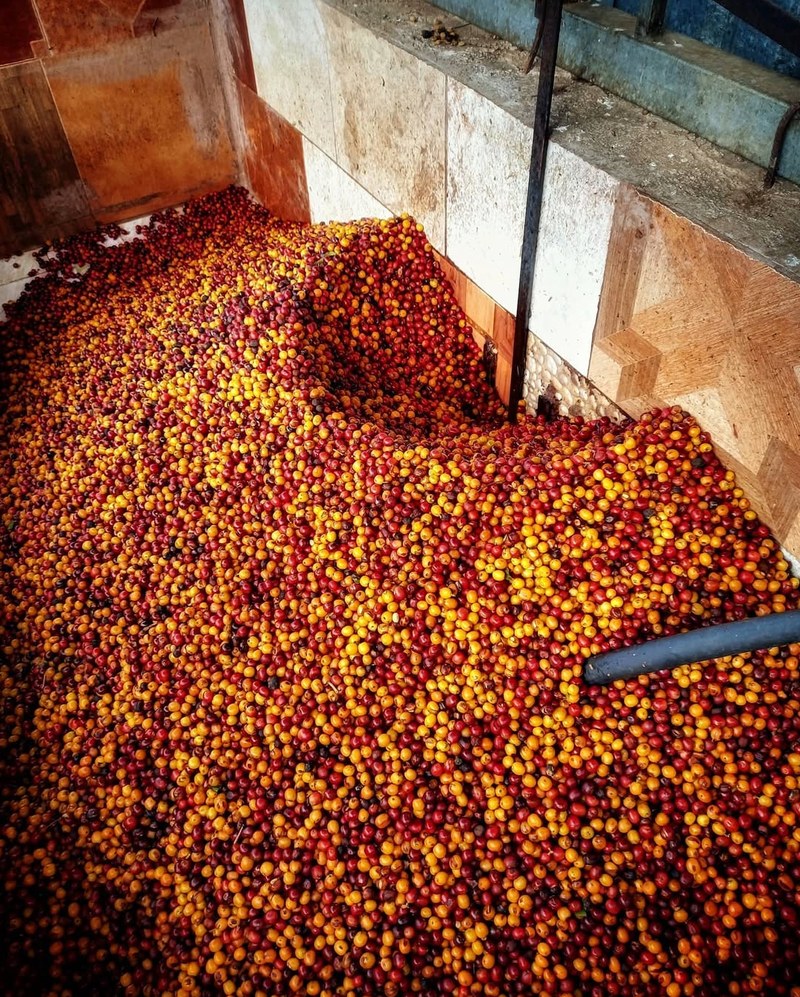
The washed method uses a machine to first remove the skin and pulp, leaving only the coffee beans wrapped in the parchment layer. At this point, the beans still have a layer of mucilage on the outside, and the washing process is meant to wash away this mucilage layer. However, the mucilage adheres strongly and is not easy to remove, so it must be placed in a tank for about 18-36 hours to ferment and break down the mucilage.
Flavor: citrus, floral, tea-like, honey, high sweetness.
Related Reading
Comments (0)
Loading comments...
You May Be Interested

Trending Reviews
Popular Videos

With you, wherever you are! We provide useful features to help you find new things you'll love






