Source:Best Coffee > News Author:qjroot Published:2024-10-16 19:00:42
According to Ethiopian media reports, the National Bank of Ethiopia (NBE) introduced a new policy on October 15 that limits the spread between the buying and selling rates of foreign exchange transactions to 2%. This policy adjustment will take effect on October 16, 2024, and was implemented after a review of the foreign exchange market following the adoption of a new foreign exchange system in July 2024.

According to an announcement by the National Bank of Ethiopia, the foreign exchange trading spread should be set, and the published exchange rate generally should not exceed 2%. Banks will retain the flexibility to adjust rates based on market conditions and on the basis of transparent and principle-based negotiations with specific customers. In addition to limiting the trading spread, the National Bank of Ethiopia stated that banks must transparently disclose all fees, commissions or other charges in transactions with customers, and these charges must also be reported to the National Bank in accordance with current practice.
It is reported that at the end of July this year, Ethiopia announced a transition to a market-based foreign exchange system, as part of broader economic reforms aimed at addressing long-term distortions in the economy, narrowing the gap between the official rate and the parallel market (black market) rate, and this reform change can replace the previous exchange rate system with a more flexible approach.
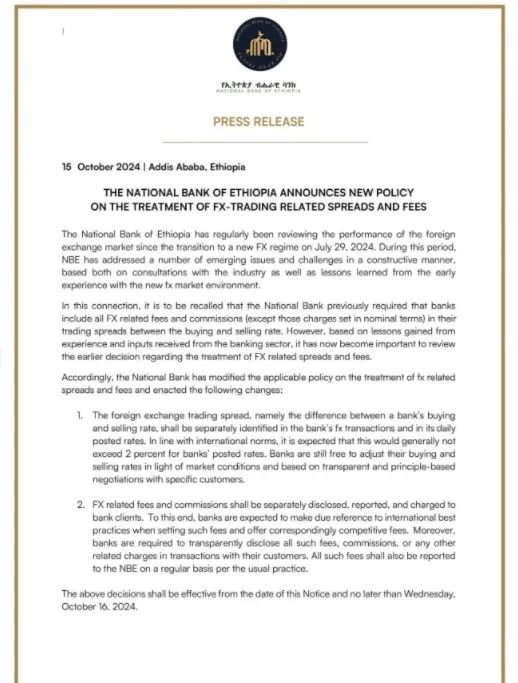
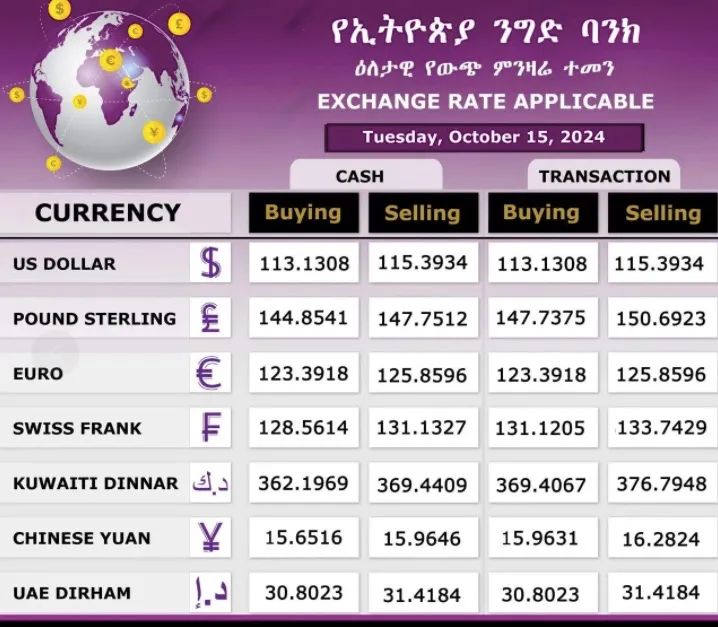
However, after its release, the exchange rate of the Ethiopian birr fell sharply. Before the new policy was issued, the exchange rate of the Ethiopian birr traded by commercial banks was about 57 birr to 1 US dollar, and the direct bid-ask spread was less than 1 birr. By October 12, the average selling price had soared to 125 birr to 1 US dollar, with a spread of more than 10 birr. However, after the National Bank of Ethiopia issued the new policy on October 15, Ethiopian commercial banks immediately adjusted their rates, setting the buying price at 113 birr and the selling price at 115 birr, narrowing the spread from 11.23 birr to 2.26 birr.
It is understood that before the policy was issued, the bid-ask spread in Ethiopia's foreign exchange market exceeded 10 birr, and such a spread had a considerable impact on the country's exports. For example, on October 14, the buying price for 1 US dollar at most Ethiopian banks was about 112 birr, while the selling price was about 123 birr. Therefore, local exporters and companies needed to pay cargo transportation costs at the higher selling rate of 123 birr, but when these exporters received export payments, banks would exchange US dollars at the buying rate of 112 birr, paying out at the lower buying price.
Therefore, higher freight costs and lower purchase prices severely affect these companies' profitability and overall business operations, and may lead some exporters to increase revenue by marking up their goods. For example, earlier, the minimum selling price of Ethiopia's main coffee bean exports rose by 2% across the board.
However, the new policy now benefits Ethiopian exporters: capping the spread between the buying and selling prices of foreign exchange transactions at 2% helps prevent banks from earning unreasonable profits through excessive spreads, thereby protecting traders' rights and interests. It also requires banks to separately disclose relevant fees and commissions to customers to ensure transaction transparency.

For Ethiopia's current main coffee industry, due to the impact of previous policies, exchange rates and the parallel market (black market), coffee cultivation and living costs have been continuously rising, so exporters can only maintain their income by raising prices. The new policy is not only beneficial to the export of coffee and other commodities, but can also reduce the cost of imported goods, thereby increasing income.
However, Ethiopia is currently still beset by internal and external troubles. In the Amhara region in the north-central part of Ethiopia, large-scale conflict has broken out in recent days, and the Ethiopian government forces and Fano armed forces are still even using weapons of mass destruction, affecting the regional economy and people's lives. In addition, 10early this month, the Houthi armed forces announced that they would continue more military operations and maintain the maritime blockade in the Red Sea region, which also continues to affect Ethiopia's import and export business. Moreover, relations with the neighboring country Somalia have still not eased, so the port issue remains one of the key problems the country needs to solve.
To learn more about coffee origin news and information, please scan the QR code to follow: Kaping
Long-press the QR code to follow:

Related Reading







Comments (0)
Loading comments...
You May Be Interested





Trending Reviews
Popular Videos

With you, wherever you are! We provide useful features to help you find new things you'll love






