Source:Best Coffee > News Author:qjroot Published:2021-12-30 18:30:23
Not long ago, when we talked about “tofu-dreg projects,” we would only think of shoddily made products; but in recent years, the coffee community has also been abuzz with “coffee-dreg projects,” such as using coffee grounds to make furniture, coffee grounds to make batteries, and so on. Among them, there was a report two years ago that Ford and McDonald’s collaborated to create car parts from coffee waste.
But even that’s not wild enough. As early as 2010, someone used coffee grounds as vehicle fuel and built a car powered by coffee waste. A team from the BBC1 show Bang Goes the Theory modified a 1988 Volkswagen Scirocco to achieve this.
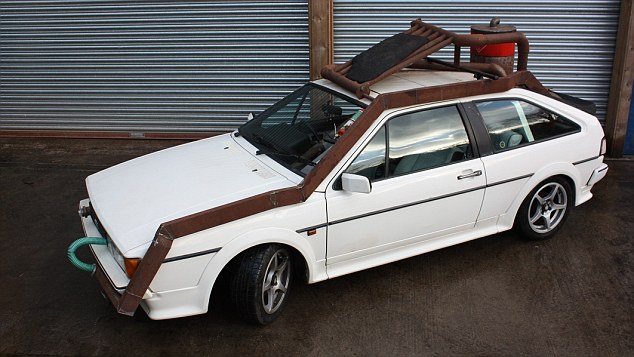
The car’s trunk was equipped with a raw material tank and a heating device, while the roof had cooling pipes. Here’s how it worked:
Coffee powder was poured into the raw material tank, and when heated to around 700 degrees Celsius, the coffee powder decomposed into hydrogen and carbon monoxide.
The gases were cooled down through the cooling pipes on the roof.
The cooled gases were then sent to a filter to remove solid particles and tar.
Finally, the filtered combustible gas was channeled to the engine to provide power.
This technology of converting coffee powder into energy is a century-old process known as gasification—using high temperatures to heat carbon-containing materials, causing them to decompose and release hydrogen.
After building this one-of-a-kind new-energy vehicle, the team even took the “coffee-ground-powered” car on a long journey from London to Manchester, covering approximately 210 miles. The team even calculated that each kilogram of coffee powder could power the car for 3 miles, meaning about 70 kilograms of coffee powder were consumed during the trip.
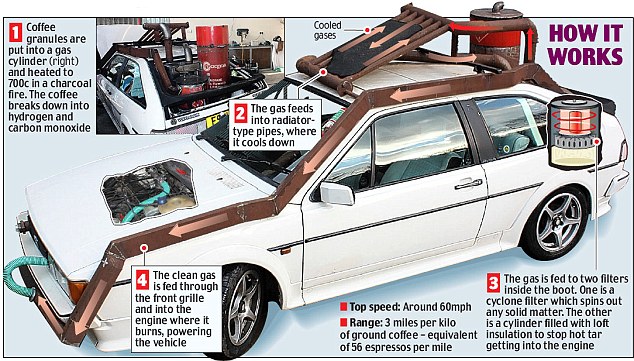
However, compared to vehicles directly using gasoline or electricity, due to the limited size of the raw material tank, the car needed to stop every 30 to 45 miles to refill coffee powder. Every 60 miles, it had to stop to clean the ash and oil residue from the filter. The top speed of this coffee-ground-powered car reached 60 miles per hour.
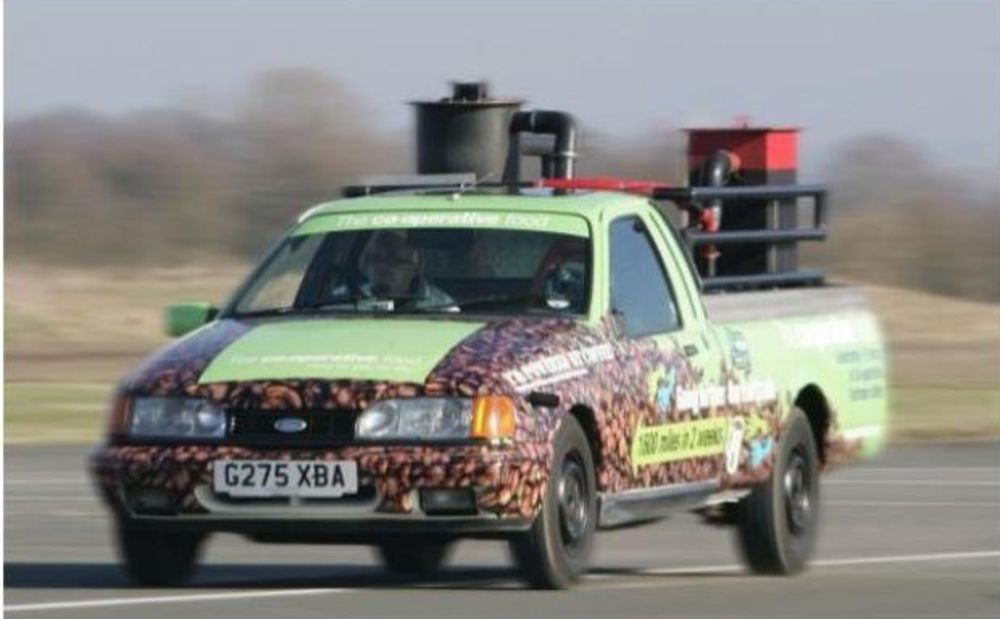
In 2013, after proving that coffee grounds could serve as valuable fuel for long-distance travel, they built a second coffee-ground-powered car modified from a Ford pickup truck, aiming to demonstrate that the vehicle could match the speed of gasoline cars. They eventually set a new record of 65 miles per hour.
With more and more reports emerging about the rebirth of coffee grounds, is there anything coffee can’t do? But in this case, even repurposing coffee grounds isn’t all that environmentally friendly. Its principle involves heating carbonaceous materials at high temperatures to produce combustible gas. Think about it—the concept is quite similar to the coal gasification power generation technology abandoned last century. The resulting gas still needs to go through a filter to remove soot and oil residue, which means it still causes some pollution.
Even today, hydrogen fuel buses on the road are cleaner and more eco-friendly than this coffee-ground-powered car. However, coffee, as the second most traded and consumed commodity in the world after crude oil, also produces coffee grounds—a waste that urgently needs to be addressed. Imagine one day being able to say, “That car has a bigger coffee addiction than I do.” Just thinking about that conversation is amusing.
Related Reading








Comments (0)
Loading comments...
You May Be Interested





Trending Reviews
Popular Videos

With you, wherever you are! We provide useful features to help you find new things you'll love






