Source:Best Coffee > News Author:qjroot Published:2024-12-10 18:42:25
Ethiopian coffee has always been known for its rich floral and fruity aromas and its lively, bright fruit acidity, which sets it apart from the traditional mellow flavor of coffee. That is why it is the first choice for many people when they enter the world of specialty coffee. So why does Ethiopian coffee have fruity flavors?
First, coffee flavor and quality both come from the coffee's place of origin, including its climatic factors and growing environment. As the birthplace of Arabica coffee, Ethiopia has a superior geographical environment. The country is located in East Africa and is traversed the entire length of its territory by the East African Rift, which has brought it numerous mountains, volcanoes, lakes, plateaus and woodlands.
The coffee-growing regions are basically located in the southwest of the country. Although Ethiopia is close to the equator and lies in the tropics, the country is generally at a high elevation, and coffee is grown mainly at altitudes between 1,100 m and 2,350 m. The large temperature difference between day and night slows the growth rate of the coffee fruit and develops more flavors, and the higher the altitude at which the coffee grows, the lower the density of the coffee beans and the greater their hardness. Together with the microclimates formed by the country's varied terrain, this helps Ethiopia's coffee develop citrus and berry-like fruit flavors and aromas.

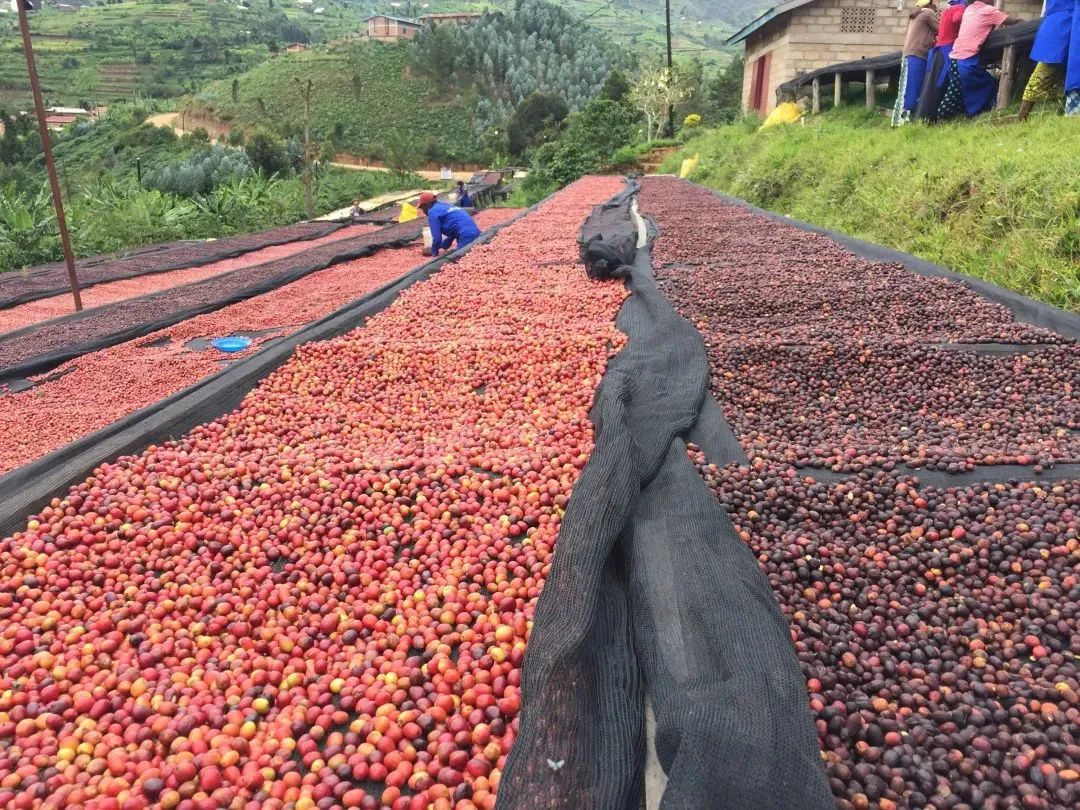
Because its climate is also relatively dry, Ethiopia commonly uses sun-dried and washed processing methods as the main approaches. Sun-dried processing is the direct drying of coffee cherries in the sun until dry; this process lasts for 3-4 weeks, during which the whole coffee cherry takes part in the fermentation process, so the coffee beans absorb the sugars from the pulp and mucilage layer, making the coffee's flavor expression sweeter. In addition, coffee itself is a fruit, so it carries a fruity flavor profile, and its drying process also absorbs the fruity flavors of the pulp.
Initially, Ethiopia used the ancient sun-dried processing method, and later, in 1972, the washed processing method was introduced. Because the washed processing method uses a large amount of water, it can reduce the coffee defect rate and make the flavor cleaner, so many local people use washed processing.

The washed process involves pulping the coffee cherries, then placing them in fermentation tanks to be stirred and soaked for 12-48 hours, during which the mucilage layer is separated, after which the coffee beans are rinsed clean with fresh water and finally dried. Therefore, during the drying period, only the coffee beans themselves take part in fermentation; the fermentation lacks pulp and uses a large amount of water, so cleanliness is higher, and the flavor expression is therefore more acidic.
In addition, Ethiopia's coffee cultivation models are mainly divided into garden cultivation, estate cultivation and forest cultivation, of which the most common is garden cultivation, where coffee farmers plant coffee trees in their own backyards and farmland, and each household's planting area is not large. When the harvest season arrives, after picking, the coffee farmers hand everything over uniformly to nearby processing stations or cooperatives for processing and export.

In addition, under the forest planting model, coffee trees grow in the forest, and only when they reach maturity do farmers enter the forest to harvest the coffee cherries, which are then exported after processing. Because Ethiopia grows a vast number of coffee varieties, with over ten thousand coffee varieties, but most of them are unidentified and unclassified varieties, making it difficult for coffee farmers to identify them, they are locally labeled as "Heirloom," known in Chinese as native species or heirloom. As a result, Ethiopian coffee beans appear in various shapes with uneven sizes.
Due to the characteristics of Ethiopian coffee, with beans of uneven size, a light roast is used during roasting to avoid burning the small beans. Therefore, using a light roast gives Ethiopian coffee beans more floral and fruity acidity notes.

For example, FrontStreet Coffee's Ethiopian Yirgacheffe coffee beans, processed by the washed method and lightly roasted, when brewed by pour-over, can distinctly bring out jasmine floral notes, citrus and berry fruit flavors, a lemon-like acidity, and a clean, refreshing mouthfeel.
To learn more about coffee origins and news, please scan the QR code to follow: Kaping
Long-press the QR code to follow:

Related Reading








Comments (0)
Loading comments...
You May Be Interested






Trending Reviews
Popular Videos

With you, wherever you are! We provide useful features to help you find new things you'll love






