Source:Best Coffee > News Author:qjroot Published:2024-09-17 18:53:47
Recently, the International Coffee Organization (ICO) released its August coffee industry report. According to the report, the monthly average composite coffee price index was 238.92 US cents/lb, up 1% from July, but up 54.6% compared with the same period last year. During the whole of August, prices fluctuated between 222.58 US cents and 254.12 US cents.
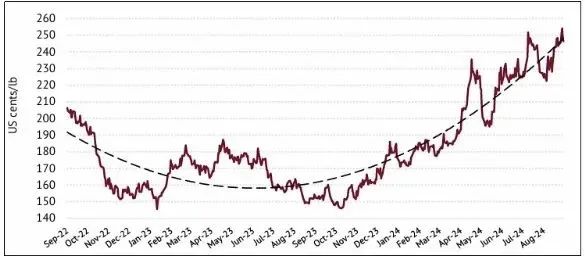
In August, spot prices for all categories of coffee rose to varying degrees, with robusta coffee prices remaining at their highest level in nearly 47 years for two consecutive months. In addition, in coffee futures, robusta also broke records, reaching 5,285 USD per tonne.
The wild price increases are all due to tightening supply caused by global climate deterioration, higher interest rates increasing capital costs, and logistics problems caused by Middle East geopolitics. According to export conditions by region, exports from the Asia-Pacific region and the Central America region declined, with the Asia-Pacific region down 8.1% and the Central America region down 7.1%.
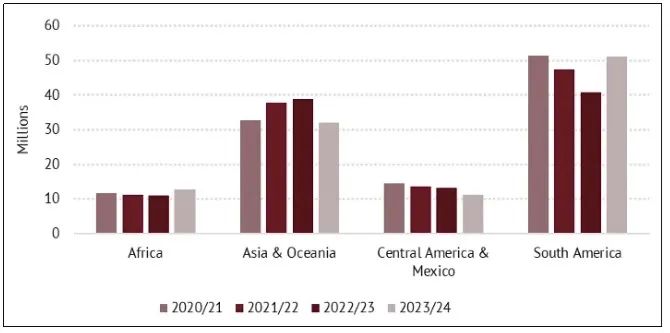
In the Asia-Pacific region, early this year Vietnam reported severe drought conditions, leading to a serious drop in production as well as a decline in export volumes. According to a report from Vietnam Customs, in August Vietnam exported a total of 1.216 million bags (60 kg/bag); although this was higher than the previously expected 1.16 million bags, it was down 14.1% compared with the same period last year. Moreover, since the 2023/24 crop year, Vietnam's cumulative coffee exports have reached 23,441,199 bags, down 12.71% compared with the same period last year.
Although South America performed well in coffee exports in August, in September several South American countries reported severe fires, including Colombia, Peru, Brazil and Bolivia. In addition, the fire sites were mostly located in these countries' coffee-producing regions, and combined with the recent prolonged high-temperature and dry weather in South America, this intensified the fire situation and brought serious impacts.

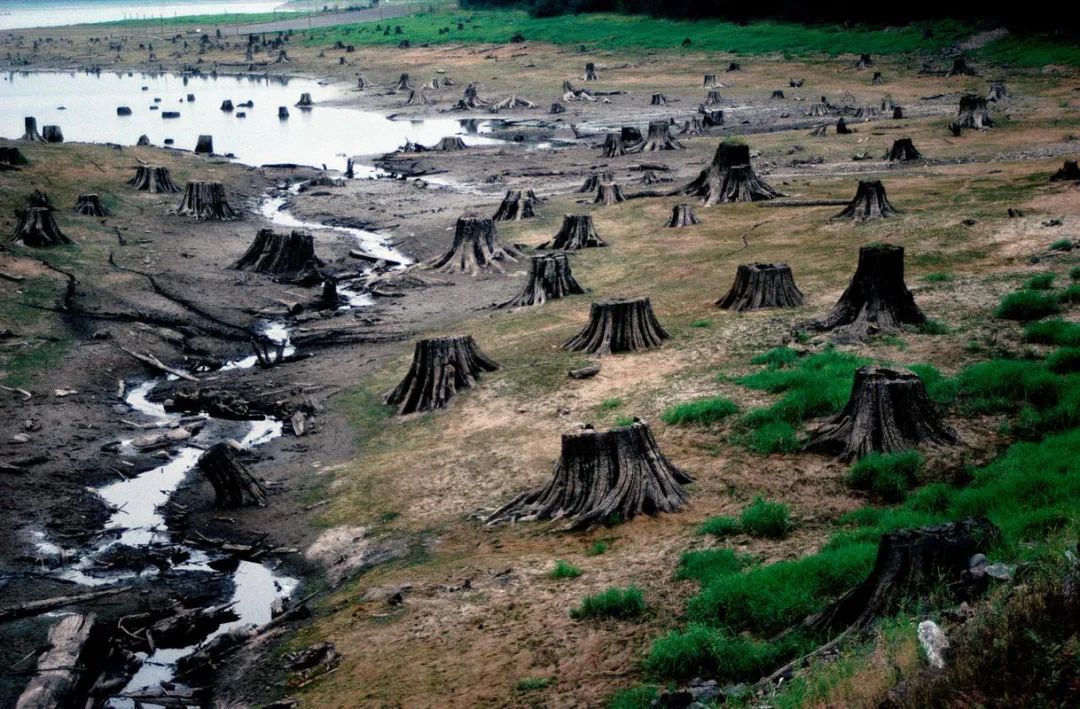
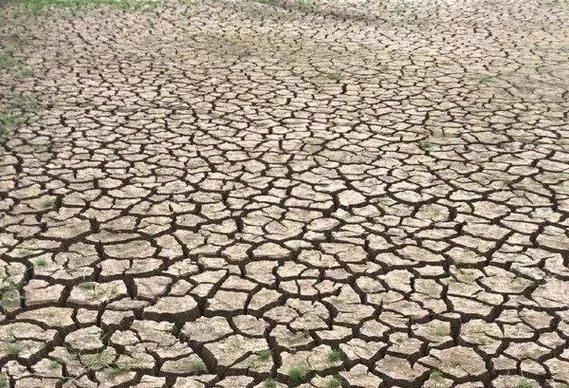
In Brazil, the country had already completed the coffee harvest of the new crop season by the end of August, but during the new crop harvest period there were continuous reports that Brazil was experiencing drought and little rain, which led to the problem of smaller coffee beans and affected the final coffee output. In addition, in recent times many parts of Brazil have still suffered from severe drought, resulting in water shortages and also triggering serious fires; farmland in some areas was burned, and serious air pollution was also caused. This has an impact on the current coffee growing and flowering period and will affect the coffee output of next year's new crop season.
In addition, the current crazy price rise is also related to the EU. Last year the EU issued the Deforestation Regulation (EUDR), a law that will restrict deforestation linked to many agricultural products imported by the EU, including coffee, and will officially take effect on December 31, 2024. Therefore, many coffee traders in the EU have recently increased their purchasing volume and are even willing to pay higher prices to buy, in order to ensure sufficient inventory before the EUDR takes effect, as these purchasing activities have greatly pushed up market prices.
However, the International Coffee Organization forecasts that global coffee production in 2023/24 will rise 5.8% year on year to 178 million bags, of which Arabica production is expected to be 102.2 million bags and Robusta production is expected to be 75.8 million bags, and it forecasts that global coffee consumption demand in 2023/24 will grow 2.2% to 177 million bags.
But quite a few industry insiders are not optimistic about this figure, all because La Nina weather will be faced at the end of the year. According to the latest report from the World Meteorological Organization, the probability of La Nina occurring from September to November this year is 55%, and the probability of La Nina occurring from October to February next year will increase to 60%. Once La Nina occurs, it will bring negative climate effects to many countries, and the possibility of production declines will arise.
To learn more about coffee origins and news, please scan the QR code to follow: Kaping
Long-press the QR code to follow:

Related Reading







Comments (0)
Loading comments...
You May Be Interested




Trending Reviews
Popular Videos

With you, wherever you are! We provide useful features to help you find new things you'll love






