Source:Best Coffee > News Author:Best Coffee Published:2019-11-07 18:31:25
Have you ever had this experience: when you're at a café having coffee and chatting with the barista, they often ask, "How do you like this cup of coffee?"
At such moments, you’ll always see coffee enthusiasts throwing out adjectives left and right—"This coffee smells intensely of jackfruit with subtle notes of blackcurrant, along with fermented wine-like aromas, flavors of blackberries, citrus, cherry tomatoes, mango, purple grapes, as well as creaminess and brown sugar sweetness..." 」。
But when it’s your turn to take a sip, you find yourself staring intently at the rich flavor descriptions on the coffee bean bag’s label, and hoping to detect those "in-your-head" flavors—but in the end, you can only say, "Damn, it smells amazing," and nothing else. Sometimes you even wonder if you’re drinking the same coffee as them.
So why is it that two people can taste such vastly different things from the same cup of coffee? Why can’t I taste all the flavors listed on the flavor wheel? ?
In daily life, the term "flavor" is more commonly used to mean "taste" or "mouthfeel," which in English is "flavor." In coffee tasting, we usually describe it as "profile." To put it simply, in Sichuan cuisine, we have many profiles, such as fish-fragrant or sweet-and-sour. Similarly, in coffee, we use terms like floral profile, fruity profile, or caramel profile to describe tastes. But the issue of coffee flavors puzzles many beginners.
Let’s take a small example from the SCAA Flavor Wheel: the chocolate aroma from the Maillard reaction—like milk chocolate, dark chocolate, or white chocolate. Unless you’ve had specialized training or a high level of tasting skill, beginners often can’t distinguish between these three types of chocolate flavors.
For those who love specialty coffee, this SCAA Flavor Wheel shouldn’t be unfamiliar, but many say they can’t understand it. So today, let’s briefly explain the structure of the flavor wheel and what its expressions mean.
The flavor wheel is divided into negative flavor profiles on the left and normal flavor profiles on the right.
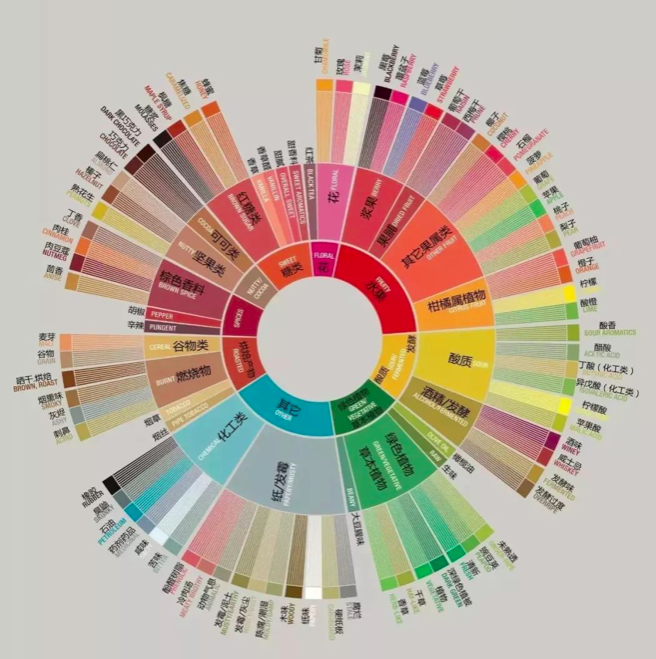
Let’s first talk about the right half of the right-side flavor profile.
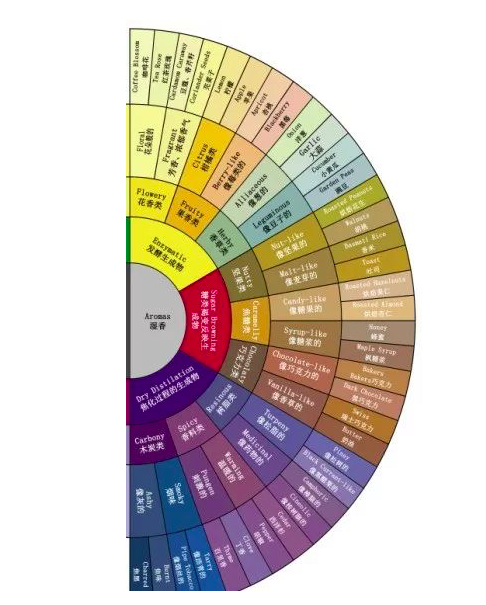
This section mainly covers the classification and formation reasons of coffee aroma and flavor.
Enzymatic (fermentation): These are flavors produced during the green bean processing (such as washed, natural, or honey process) due to fermentation, like floral and fruit notes.
Sugar browning (sugar caramelization reaction): This part includes flavors produced during the roasting process through caramelization and Maillard reactions, such as nuts and chocolate.
Dry distillation (dry distillation reaction): These are flavors generated during the roasting process via dry distillation, like gooseberry and smoky notes.
Some say that "the flavor wheel, from top to bottom, also represents flavors produced by different roasting levels," but in reality, dry distillation reactions begin as soon as roasting starts, so this statement isn’t entirely accurate.
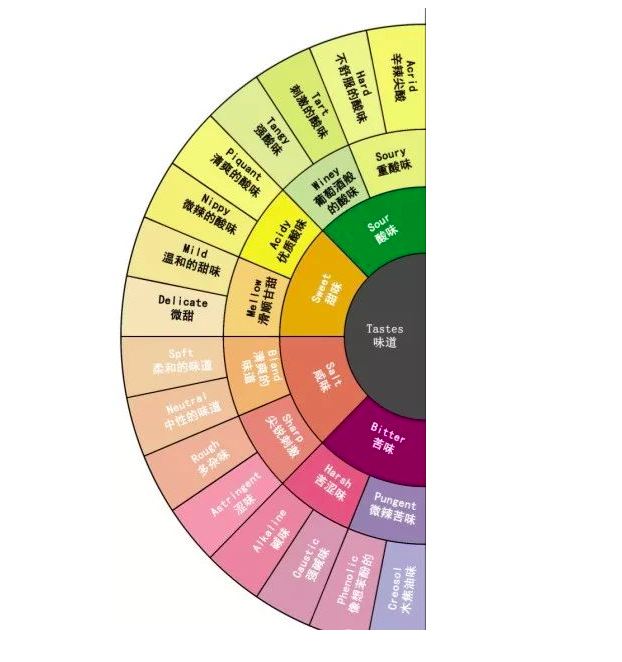
Now let’s talk about the left half of the right-side flavor profile.
This part is straightforward, basically categorizing basic tastes—acidic, sweet, bitter, and salty—into different sensory classifications. It’s said that umami may be added to the flavor wheel in the future.
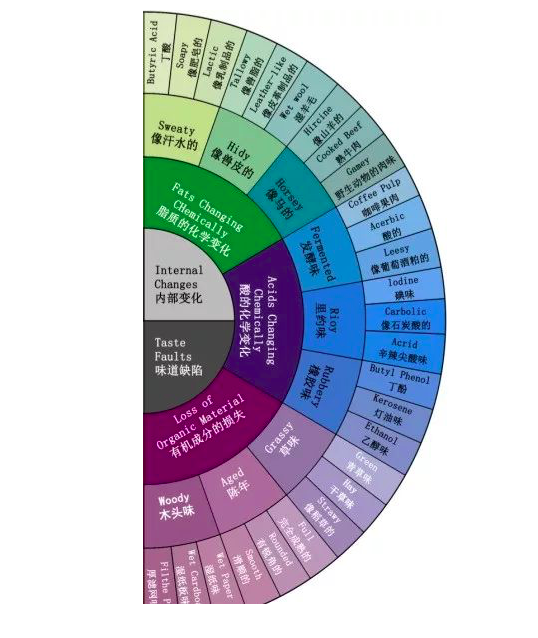
Now let’s discuss the left-side flavor profile, starting with the right half.
This part refers to defective flavors caused by improper handling during the coffee harvesting and drying stages, as well as aged flavors developed during storage.
If not processed or dried promptly after harvesting, or if the humidity and temperature during drying are unreasonable, fermentation can produce Rioy or fermented flavors. During drying, excessively high temperatures or too rapid heating can break down coffee bean oils, creating leather-like notes.
During the post-processing storage of green beans, internal reactions continue, organic matter gradually changes and depletes. Fresh beans may have grassy notes, and after a few years, due to the loss of organic matter, they may develop straw or wooden flavors, making the coffee taste rather dull.
Finally, let’s talk about the left half.
This part involves changes caused by external factors (cleanliness, humidity, etc.) during the green bean processing and storage phases, as well as flavors resulting from whether roasting temperatures were appropriate.
During green bean processing, if the drying environment is unclean—like drying beans on the ground—the coffee can absorb surrounding odors, producing earthy notes. Or if the space is too humid and the beans dry too slowly, mold may grow, resulting in musty flavors.
During roasting, if the temperature rises too quickly and the beans are scorched, it can produce smoky or carbonized flavors. If the temperature rises too slowly, it can dull the coffee’s flavor, making it seem flat and uninteresting.
The two items on the right—"fats changing chemically" and "acids changing chemically"—that produce defective flavors are considered serious defects and will result in a deduction of 4 points if detected during SCAA cupping. The two items on the left—"fats absorbing odors" and "fats absorbing tastes"—are considered minor defects and will result in a deduction of 2 points if detected. The bottom two items—"improper roasting" and "loss of organic material"—are not classified as green bean defect flavors, so no defect points are deducted, but they will lower the score for flavor expression.
These 85 flavors in coffee don’t mean there are 85 kinds of flavored coffee, but rather that during planting, processing, and roasting, coffee develops different flavors due to influences such as environment, genetics, processing methods, storage and transportation, roasting level, and the roaster’s skill.
Coffee flavor is actually complex and multi-layered. To truly understand coffee, three conditions are needed:
First: Have you had similar taste or smell experiences? For example, if you’ve never eaten a peach, you obviously won’t be able to identify its flavor.
Second: It’s recommended that you wait until the coffee has completely cooled before tasting, because usually, the fruity profile of coffee becomes more recognizable when it’s cooler, and coffee flavors unfold as the temperature drops.
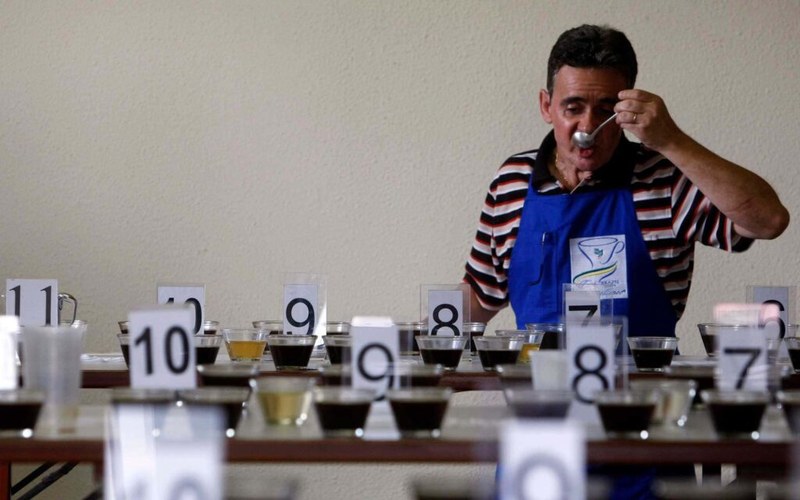
Third: The strength of the coffee also affects its profile. For lighter-roasted, high-profile coffees, it’s suggested to brew them a bit lighter to spread out the flavor spectrum, making it easier to identify the nuances (this explains why the cupping ratio is 1:18.18).
Related Reading



Comments (0)
Loading comments...
You May Be Interested

Trending Reviews
Popular Videos

With you, wherever you are! We provide useful features to help you find new things you'll love






