Source:Best Coffee > News Author: Published:2019-07-08 21:08:07

Hacienda La Esmeralda Bouquete
The birthplace of the renowned Geisha (Gesha) is Hacienda La Esmeralda in the small mountain town of Bouquete on the eastern slope.

Bouquete, with its beautiful mountains and waters, has always been a haven for European and American elites to enjoy their retirement. Of the town's 20,000 residents, over 2,000 are high-end immigrants from abroad. The coffee farm owners here speak and write English and European languages fluently, possess a worldly outlook, and have the highest ratio of PhD and master's degree holders among all coffee-producing countries.
As early as 1904, when the Panama Canal was first being built, a large number of European engineers and senior managers were hired to work in the sweltering heat of Panama City in the east. In 1917, after the Panama Canal was completed, this group of highly educated professionals, especially Scandinavians, fell in love with Bouquete, Panama. The climate here is cool, spring-like all year round. Many stayed, bought farms, and retired here, enjoying the rosy clouds, mist, and fragrant surroundings.

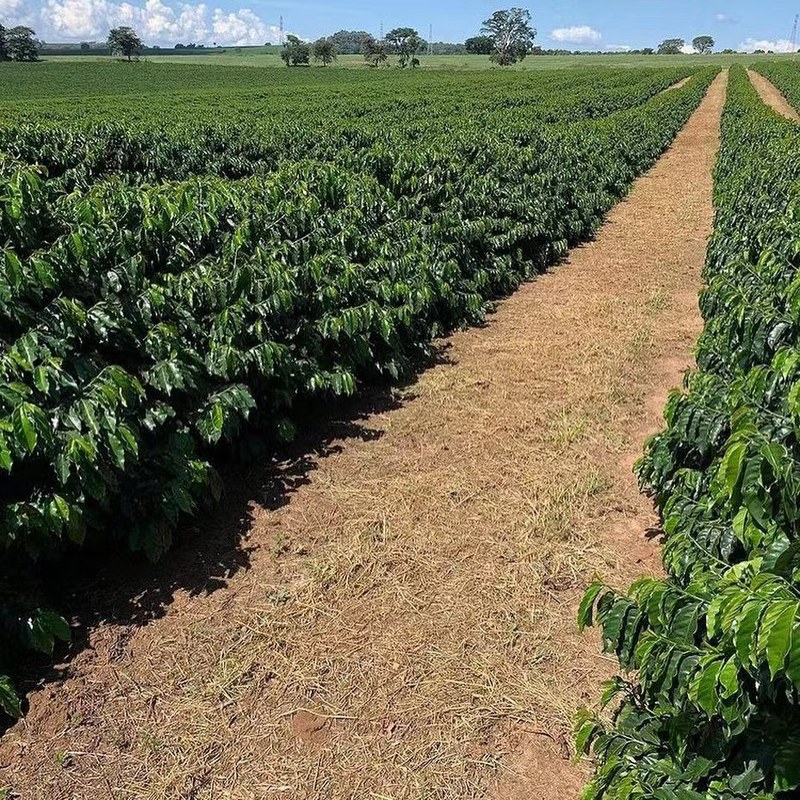
Coffee trees under shade
It can be said that the retired European engineers of a century ago were the pioneers of today's Bouquete livestock and coffee farming industries. The advanced wet mills and agricultural infrastructure here are all the handiwork of those engineers.
Hacienda La Esmeralda (Bouquete)
Hacienda La Esmeralda is located at a corner of the Baru volcano, so the coffee beans produced in this area were mostly named after Baru Mountain before they became famous. The surrounding area of Bouquete is scenically beautiful, with many resort hotels, villas, and vacation estates, some even built along the important Rio Caldera river. Hacienda La Esmeralda is located at Jaramillo on the right side of this river, and coffee was later planted at even higher elevations on the left side of the river at Canas Verdes. All of this is thanks to Rudolph Peterson's decision to purchase this property back then.
The Peterson Family
Rudolph A. Peterson, the first-generation owner of Hacienda La Esmeralda

In 1964, Swedish-American financier Rudolph A. Peterson retired, moved to Panama, and bought Hacienda La Esmeralda in Bouquete, focusing primarily on dairy. He had served as president of Bank of America and was a major figure in the financial world at the time. Rudolph bought Hacienda La Esmeralda merely for vacations and later retirement use. He probably never anticipated that this estate would become world-famous, even becoming the representative estate of Panamanian specialty coffee. In 1973, his son Price Peterson earned a PhD in neurochemistry in the United States but returned to Bouquete to help his father run the farm. After taking over, Price segmented the market by altitude and microclimate, as well as by cupping performance and cultivated varieties, creating three major brands for sale (Esmeralda Special, Diamond Mountain grows, Palmyra). Starting in 2012, Geisha was added, making it four major brands.
Hacienda La Esmeralda actually comprises 4 farms: Ca?as Verdes, El Velo, Jaramillo, and Palmira. All coffee beans are sent to these 4 farms for processing. The first farm purchased by the Peterson family was Palmira.
1. Esmeralda Special, which is Hacienda La Esmeralda's own independent auction, entirely Geisha, auctioned by production block name, with each block further subdivided into small lots for bidding. Only Geisha lots that the estate puts up for independent auction can use the Esmeralda Special name. Starting in 2013, Esmeralda Special had nine lots.
El Velo Farm of Hacienda La Esmeralda

El Velo Farm was acquired by Hacienda La Esmeralda in 2012 and is the newest farm in the estate. This farm has already received Rainforest Alliance Certified status, demonstrating Hacienda La Esmeralda's environmental friendliness and conservation awareness.
El Velo Farm covers 50 hectares. In addition to growing Geisha and Catuai varieties, the farm also cultivates a small amount of exotic varieties such as Laurina, Pacamara, Mocha, and SL28, as well as over 400 other varieties obtained from CATIE, all planned as part of the farm's long-term commercial exploration.
Although the land of this farm winds upward along the mountain range to an altitude of 3,900 m, the coffee is planted at elevations between 1,650 and 1,900 m. A nature reserve is established here, home to the famous resplendent quetzal and other endangered birds.
Hacienda La Esmeralda's special micro-lots are called Prueba lots

Prueba means "experiment, test" in Spanish. In the relentless pursuit of improving coffee quality, Hacienda La Esmeralda not only works tirelessly on variety selection and cultivation but also continuously experiments with new processing methods.
For example, the coffee cherries harvested for Prueba 4 came from the Porton plot of El Velo Farm. This batch of coffee beans underwent a titanium dioxide soaking process. First, ripe red coffee cherries were depulped, then the depulped cherries were placed in a sealed tank filled with titanium dioxide for 62 hours. The cherries were then dried on a concrete patio for 32 hours (with pectin still remaining, so it is a honey process), with the patio temperature controlled between 17°C and 24°C.
Prueba 4 belongs to a special innovative lot from Hacienda La Esmeralda's special reserve plot. Since 2004, this rare coffee cultivation reserve plot has won more than 15 international awards. The coffee produced here does not participate in Hacienda La Esmeralda's auction and is sold in small batches through direct trade.

2. Geisha, which is the Geisha variety but not lots from the independent competition. It is a blend of beans from various production blocks that do not participate in bidding but still have excellent quality. It is still the Geisha variety. This brand strategy was launched in 2012.
3. Diamond Mountain grows, Hacienda La Esmeralda's traditional varieties, planted in the Canas Verdes and Jaramillo areas at approximately 1,400-1,700 m elevation. The coffee has a complex mouthfeel with pronounced chocolate and spice sweetness. The planted coffee varieties are a standard Central American blend, including Typica, Bourbon, and Catuai. Diamond Mountain is eco-friendly and Rainforest Alliance Certified coffee.

4. Palmyra, this brand's coffee is near the Baru Volcano National Park area and is Hacienda La Esmeralda's commercial coffee, at 1,100-1,200 m elevation, planted entirely with Catuai. This is the only area at a lower growing elevation. Although not specialty grade, it has the typical Panamanian Bouquete coffee flavor. The acidity is not too sharp, with nutty sweetness and vanilla-chocolate flavors. Palmyra is actually La Esmeralda's highest-yielding coffee, accounting for about 70% of the entire family's coffee production.

The Discovery Story of Hacienda La Esmeralda's Geisha
In 1980, Price introduced Caturra and Catuai varieties, and in 1994 established a wet mill. In 1996, Price heard that a nearby estate in Jaramillo had good coffee with a strong citrus flavor, so he bought the Jaramillo coffee farm and merged it into Hacienda La Esmeralda. In the early days, the Peterson family blended and sold coffee from both estates, but always sensed a subtle orange-blossom honey flavor and elegance, a flavor profile quite different from the plum and berry notes of Central American coffee.
One day in 2002, Price's son Daniel had an inspiration and believed this flavor profile must come from a single variety in a particular planting area. So he cupped every variety from different elevation planting areas on the estate one by one.
The cupping results came out: the crowd-pleasing floral-honey notes and citrus elegance actually came from the windbreak at the edge of Jaramillo. This area has the highest elevation, approximately 1,500-2,000 m. The coffee trees were tall and thin with sparse leaves, unremarkable in appearance. The vertical spacing between branches was larger than normal coffee trees, and the distance between each bud node on the branches that flowers and bears fruit was as long as 7.26 cm. This meant that within the same branch unit, the areas available for flowering and fruiting were not dense enough. It was a low-yield variety with low economic value, which is probably why the previous estate owner relegated it to the most remote, windiest area as a windbreak to shield other shorter-internode, denser, high-yield varieties from strong winds.
Price and Daniel also discovered that these strange-looking, low-yield coffee trees were also scattered below 1,400 m in Jaramillo at lower elevations, but the flavor profile was very different: not only was the orange-blossom honey flavor gone, but the bitterness was stronger.
The two concluded that the unknown coffee trees in the windbreak possessed unique genetics and must be grown above 1,500 m elevation, tempered by cold moonlight, wind, and mountain air, to produce their extraordinary flavor profile.

Washing tanks

Ordinary coffee varieties cannot survive in the Jaramillo windbreak because the winds are too fierce and the temperature too low, yet these tall, thin coffee trees thrived there. Their coffee cherries were also plumper than ordinary varieties and not easily blown off. Although production was scarce, the orange-blossom honey flavor was intoxicating. What variety could this be?
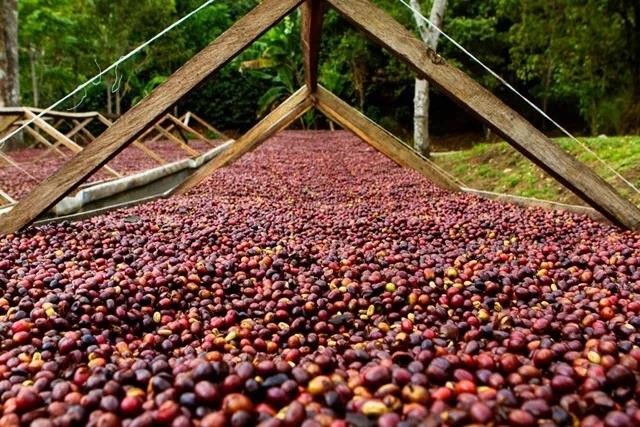
Drying patio

After consulting many sources, it was learned that this variety is called Geisha. It was introduced in 1963 by Don Pachi, an Italian-descended person working for the Ministry of Agriculture. However, because it was all planted at 1,200 m elevation, with low yield, small thin beans, and poor flavor, it was abandoned.
Large-scale processing equipment
In 2004, Jeff, an intellectual green bean purchasing expert, served as a BOP judge. He recalled: a total of twenty-five Panamanian specialty coffee beans entered the finals, but one of them puzzled the judges. Its citrus notes, lime acidity, sugarcane sweetness, jasmine fragrance... filled the room. Sipping it was like a hundred flowers blooming, fireworks exploding in the mouth. Even Ethiopia's Yirgacheffe could not have such intense orange-blossom honey notes. The champion bean was decided. Estate owner Price explained to everyone that this bean was the Geisha variety, and Geisha's fame took off from there.
Natural processing
Even among Geisha, forms differ and flavor profiles vary. Panamanian Geisha has pointed, elongated, plump beans rich in orange-blossom honey flavor; Ethiopia's "Variety 75227," also called Geisha, has pointed, elongated, small thin beans with ordinary flavor; as for Geisha from Costa Rica, Kenya, and Malawi, the beans are short and round, with a flavor profile like a diluted version of Panamanian Geisha.

Even Geisha from Panama's Hacienda La Esmeralda varies in quality, with size differences depending on the altitude of the growing area and harvest period. Basically, the higher the altitude of the small production area, the more expensive. In recent years, the record-breaking Geisha has come from Jaramillo. Mario Geisha at 1,500-1,650 m elevation is harvested in February. Montana Geisha from Canas Verdes, at 1,700-1,800 m elevation, fetched over 200 USD per pound at auction. Production areas below 1,500 m are lower in value, available for around ten-plus USD per pound, with much fainter orange-blossom honey notes and subtle miscellaneous bitterness.
Geisha from Panama's Hacienda La Esmeralda accounts for at most 4%-5% of the estate's total coffee production.
Hacienda La Esmeralda's Award Record - Unprecedented Auction Records

Hacienda La Esmeralda's award record and number of wins are unprecedented. As of 2013, it had won 15 championships in different coffee competitions. Four of its auction prices were world records at the time, especially the 2013 Best of Panama Natural category champion natural Geisha lot, which sold for an astonishing 601.25 USD per pound!
In 2007, Hacienda La Esmeralda sold at 130 USD per pound at the Best of Panama annual auction, shocking nations and causing media to compete for interviews. Competitions in other countries, such as the Cup of Excellence, also have records of award-winning beans fetching high prices, but long-term observation of international auctions reveals that every record set by Hacienda La Esmeralda was the highest price in that year's coffee auctions! Moreover, no country's auction price has ever surpassed Hacienda La Esmeralda's high records.
How to Distinguish Hacienda La Esmeralda's "Red Label," "Green Label," and "Blue Label"!
After years of experimentation, Hacienda La Esmeralda found that only Geisha beans harvested from coffee trees growing above 1,400 m elevation can display the special flavor that Geisha beans should have. So the main grading is based primarily on growing altitude, supplemented by actual cupping results, dividing Geisha beans into "Red, Green, Blue Label" grades.

Top grade - Red Label [Auction Lot]
* Growing altitude 1,600-1,800 m
* Cupping score above 90 points
* Mainly from Jaramillo and Ca?as Verdes estates, also the highest quality Geisha beans
* Geisha beans harvested from the highest points of the Bouquete mountain area, with special, bright floral fragrance and citrus aroma
* Coffee of this grade is processed into natural or washed green beans
* Can only be purchased through the annual global auction
Second best - Green Label [Reserve Lot]

* Growing altitude 1,600-1,800 m
* Micro-lot blends from three different estates: Jaramillo, Quiel, Ca?as Verdes
* Although not the highest-grade auction beans, Geisha beans of this grade still carry the classic flavors of Geisha coffee beans: floral, fruity, citrus acidity, and a rich, juicy mouthfeel
* Selected from the most optimally ripe coffee cherries, creating a rich sweetness, bright fruit acidity, and delicious flavor
* Geisha beans of this grade are also available as washed or natural processed green beans
Ordinary - Blue Label [Select Lot]

* Growing altitude 1,500 m
* Blends from three different estates: Jaramillo, Ca?as Verdes, El Velo
* Slight floral notes, fruit acidity, sweetness, less rich mouthfeel
* Geisha beans of this grade are only available as washed processed green beans
Related Reading
Comments (0)
Loading comments...
You May Be Interested


Trending Reviews
Popular Videos

With you, wherever you are! We provide useful features to help you find new things you'll love






