Source:Best Coffee > News Author:qjroot Published:2024-08-23 18:42:05
It is reported that the Somali Civil Aviation Authority (SCAA) announced on August 21 that Ethiopian Airlines must "resolve" its "violation of Somali sovereignty" before August 23. It also threatened that if the "sovereignty violation" issue is not resolved, the Somali authorities will immediately revoke the airline's license to operate in the country.
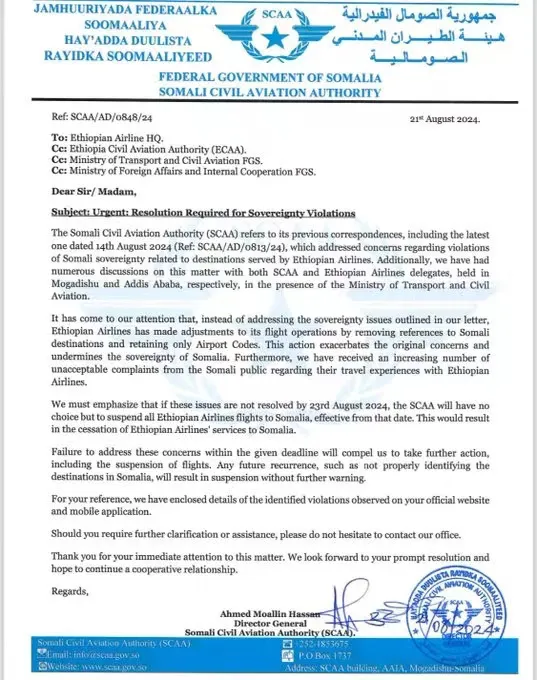
It is reported that on August 21, the Somali Civil Aviation Authority (SCAA) issued a warning to Ethiopian Airlines, requiring Ethiopian Airlines to remove "Somaliland" and other related information from its official website. It considered the appearance of the term "Somaliland" to be a violation of Somali national sovereignty, and therefore required Ethiopian Airlines to resolve the issue by August 23. Otherwise, it would suspend all Ethiopian Airlines flights to Somalia, as well as impose a ban on flights in Somali national airspace.
Then on August 23, Ethiopian Airlines responded, asking the Somali Civil Aviation Authority (SCAA) to give more time to change the website, and said that the August 23 deadline was too tight.However, SCAA subsequently replied that it rejected Ethiopian Airlines' request, saying that this modification requirement was not difficult and was feasible within the given time. Therefore, it would suspend all Ethiopian Airlines flights.

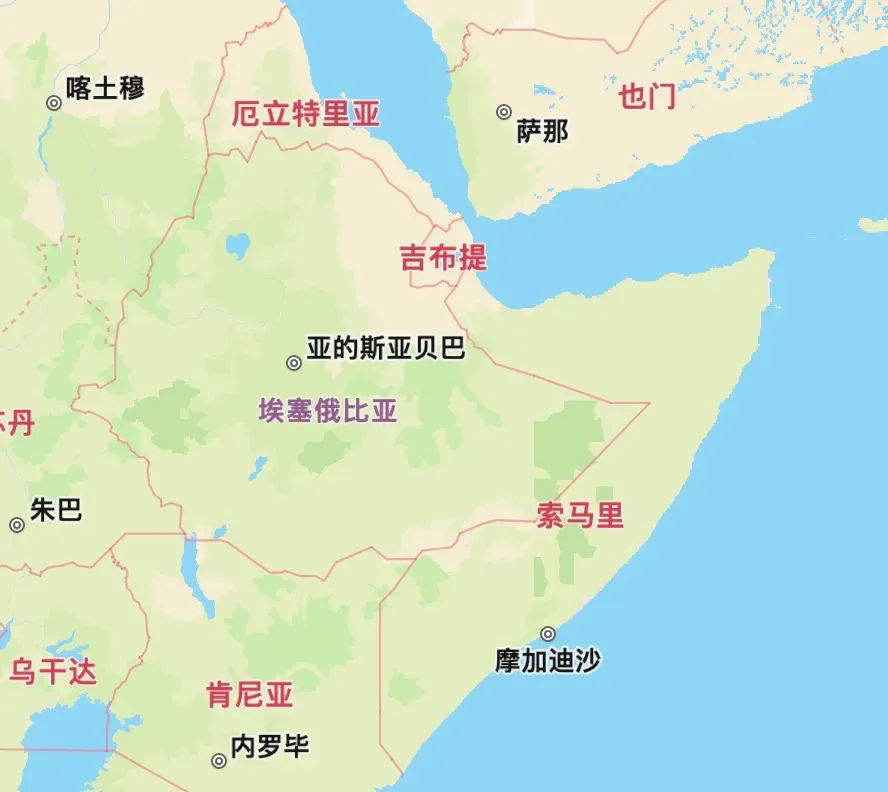
It is understood that relations between Ethiopia and Somalia have long been tense, but earlier this year the Ethiopian Prime Minister signed a memorandum of understanding with the local government of Somaliland in northern Somalia in order to obtain the right to use the port of Berbera in Somaliland, while also requiring recognition of Somaliland as an independent state. These memoranda of understanding led to a deterioration in relations between Ethiopia and Somalia.
Earlier reports pointed out that another neighboring country of Ethiopia, Eritrea, announced the suspension of all Ethiopian Airlines flights. There were also reports that Eritrea had established close relations with Somalia, and it was believed that Eritrea's suspension of Ethiopian flights was related to Somalia.
By August 14, Turkey had organized peace talks between Ethiopia and Somalia. According to reports at the time, progress was made in the talks, but a final agreement needed to be reached in the third round of talks in early September.
However, on August 19, the Somali President signed a military agreement with Egypt, and afterward accused Ethiopia at a press conference, saying that the second round of talks had failed because Ethiopia had consistently shown no respect for Somalia's sovereignty and territorial integrity. He then stated that there was no room for dialogue until Ethiopia withdrew the memorandum of understanding with Somalia.

At present, Ethiopia has not yet commented on the Somali government, and Turkey has not yet confirmed whether the third round of talks has been cancelled. Moreover, the agreement between Ethiopia and Somaliland has not been fully finalized, so Ethiopia has still not obtained the right to use the port. In addition, estranged relations with both Eritrea and Somalia are not conducive to Ethiopia's product exports.
The situation in Ethiopia is now extremely chaotic, with ongoing clashes between the national government forces and regional armed groups and the constant risk of civil war breaking out, and because of the reforms issued by the Ethiopian government, the Ethiopian currency, the birr, has depreciated sharply, causing strong discontent among the local population.

Therefore, for many industries in Ethiopia, exports are heavily relied upon, especially agricultural products such as coffee. However, due to the Red Sea crisis, import and export at the Port of Djibouti have been severely hampered. But Ethiopia's relations with two other neighboring countries have deteriorated, making it impossible to use their ports for exports.
Some coffee insiders say the outlook for Ethiopia's coffee industry is not ideal. Although a low exchange rate is favorable for exports, rising prices of necessities such as fertilizer and fuel have increased cultivation costs, and therefore the prices of commodities such as coffee have also risen accordingly, and the export problem will be difficult to solve in a short time. Rising coffee prices, combined with slow export shipping times and other issues, may greatly reduce buyers' willingness to purchase, which is not conducive to development.
To learn more news and information about coffee origins, please scan the QR code to follow: Kaping
Long-press the QR code to follow:

Related Reading








Comments (0)
Loading comments...
You May Be Interested






Trending Reviews
Popular Videos

With you, wherever you are! We provide useful features to help you find new things you'll love






