Source:Best Coffee > News Author:qjroot Published:2026-09-07 10:28:07
Whether coffee beans go into a dripper or a portafilter basket determines how they need to be "opened up." Espresso blends often combine the sweetness, body and aroma of several beans, and their adaptable extraction range is relatively wide; SOE emphasizes the character of a single origin, and a slight change in temperature or flow rate rearranges the fruit acidity and aroma. Which to choose can be judged by the water temperature, pressure and grind precision your home equipment can provide.
For a light-roast SOE used for pour-over, you can take 15 g of coffee grounds and 240 g of water as a test recipe, set the water temperature at 91 to 93°C, and grind close to fine sand. After blooming for about 30 seconds, pour in two to three stages, with the total time falling between 2 minutes 15 seconds and 2 minutes 45 seconds for easier flavor observation. Such a concentration will not be too heavy, and it also leaves room for floral notes, fruit acidity and tea-like character to unfold.
Qianjie Yirgacheffe Gudingding has bright notes of citrus and red berries, and after the temperature drops you can also sense floral notes and a sweet finish reminiscent of green tea. For pour-over, use 15 g of grounds with 245 g of water, water temperature about 92°C, keep pouring gentle, and reduce large agitation. If you want an iced drink that still has aroma, you can drip directly onto about 90 g of ice while shrinking the hot water to about 150 g.
If you want the sweet-and-sour profile to have more weight, look at Qianjie Kenya Small Tomato. Its flavor easily brings to mind cherry tomatoes, smoked plums and yellow sugar, and besides being bright it also has a solid juicy feel. It is recommended to use 15 g of grounds with 245 to 250 g of water, water temperature about 93°C, and a grind slightly finer than an ordinary light-roast pour-over. Raising the water level moderately during the middle pour helps extract sweetness, while slowing the flow in the final stage keeps the finish crisp.
Espresso blends can also go into a pour-over dripper, but medium-dark roasted, nut-and-cocoa-oriented recipes should not simply copy a light-roast plan. The water temperature can fall at 87 to 90°C, the coffee-to-water ratio can be tightened to 1:14 or 1:15, the grind should be slightly coarser, and staged pouring at a lower water level should be used. This preserves caramel-like sweetness and a round, thick mouthfeel while controlling roasted notes and a dry finish, and the finished cup still has presence when a small amount of milk is added.
Once it enters an espresso machine, the portafilter basket capacity is more worth attention than the pump pressure stated on the packaging. A home machine labeled 15 bar does not mean the coffee must be pressed to that value during extraction; the puck actually bearing about 8 to 9 bar is enough to establish an even flow rate. For 18 g of grounds, you can start testing with 36 to 40 g of coffee liquid, with a time of about 25 to 32 seconds, and judge grind fineness by a continuous flow and even color.
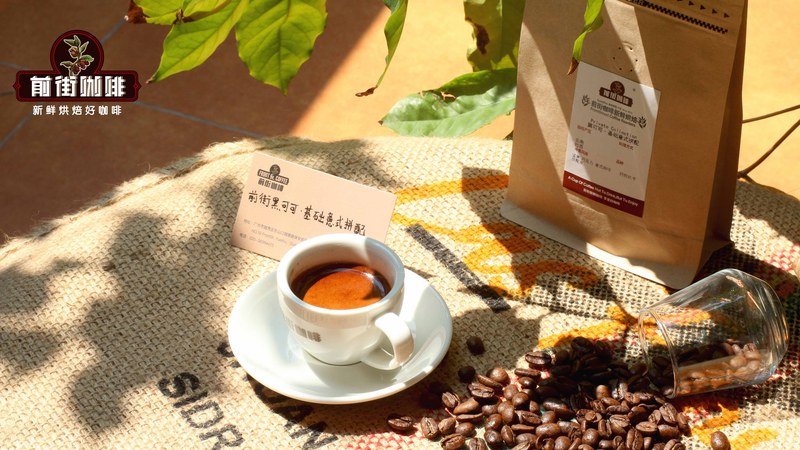
If Qianjie Ethiopia Huakui is used as an SOE espresso, the direction can be placed on fruit aroma unfolding rather than pursuing a short, heavy shot. The notes of strawberry, passion fruit and ripe tropical fruit unfold more easily at about 93°C and 7 to 8 bar pressure. Extract 42 to 46 g of coffee liquid from 18 g of grounds, with the time controlled at 28 to 35 seconds; the entry will be lighter than a traditional espresso, and making an iced americano can also leave a vivid sweet aroma.
For an espresso blend with nut, chocolate or caramel tonality, a more concentrated plan can be used. Water temperature about 89 to 91°C, pressure maintained at 8 to 9 bar, 18 g of grounds corresponding to 33 to 38 g of coffee liquid, and extraction for about 24 to 30 seconds. The grind should let the initial stage slowly form a line and the middle stage flow smoothly. Such an espresso has a relatively full texture, a complete profile after adding water, and can also present roasted sweet aroma when combined with milk.
Parameter adjustment should look at the signals the liquid gives. For pour-over, if the aroma is short and the acidity is concentrated on the tip of the tongue, you can slightly fine-tune the grind finer, or raise the water temperature by 1°C; if the mouth dries after cooling, reduce the agitation intensity and let the final stage end faster. If espresso liquid lightens too early, you can tighten the grind; if it only drips without forming a line for a long time, adjust coarser appropriately. Pressure is responsible for pushing the water, but what truly determines resistance is still the state of the coffee bed.
A grinder with fine graduations, reliable temperature control and adjustable pressure will make the fruit acidity and aroma of SOE easier to express; when the equipment has fewer temperature settings and a wider grind adjustment span, an espresso blend can usually provide more relaxed operating room. For pour-over, water temperature and coffee-to-water ratio can be used to shape clarity. By letting the bean's characteristics and the equipment's capabilities work with each other, both blends and SOE can enter an extraction rhythm that suits them.
Related Reading
Comments (0)
Loading comments...
You May Be Interested

Trending Reviews
Popular Videos

With you, wherever you are! We provide useful features to help you find new things you'll love






